The Process by Which Institutional Reform Is Achieved Through the Petition Application Support Service
The first point I would like to make is this:
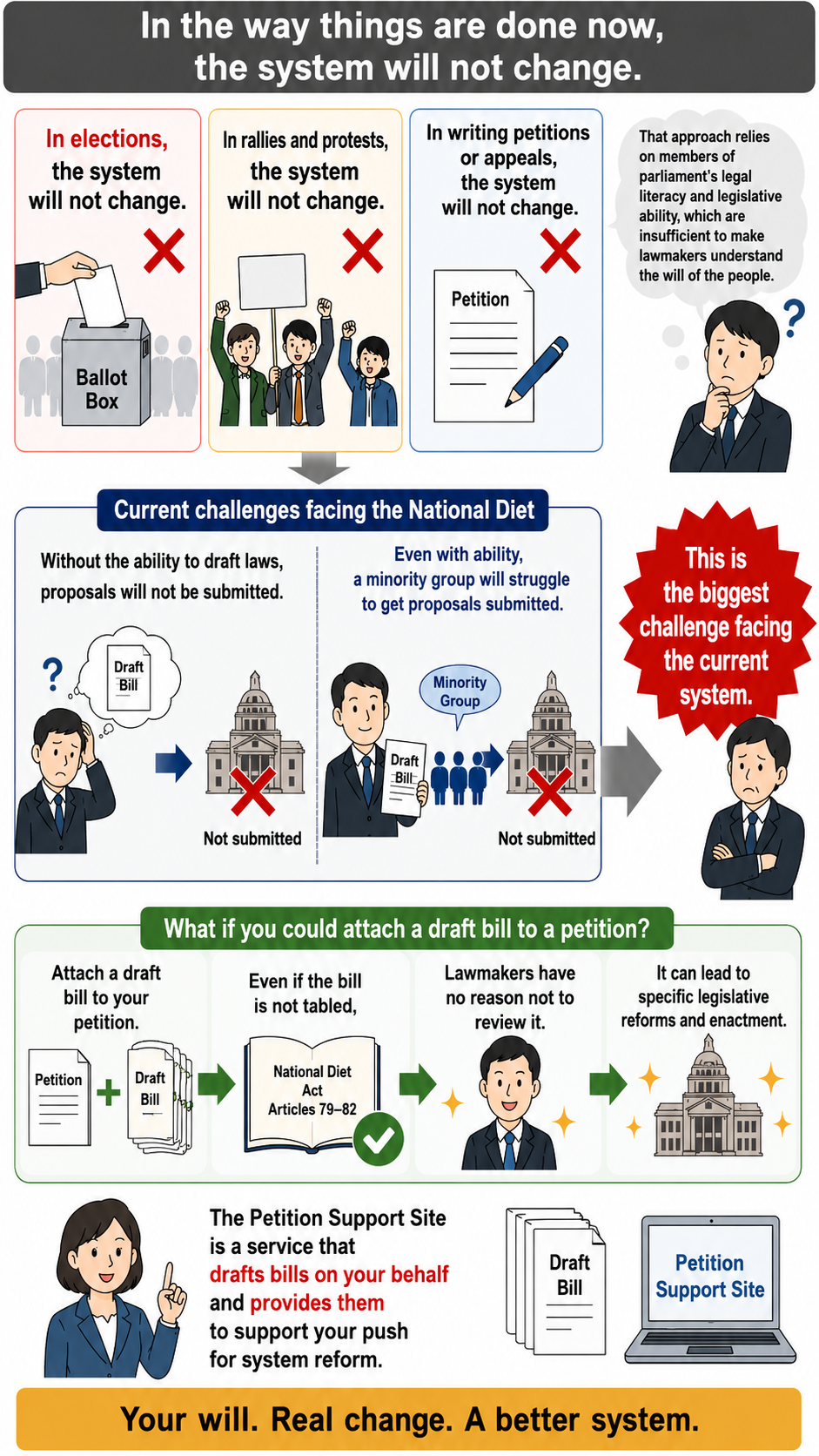
- Elections do not change institutions.
- Demonstrations and online campaigns do not change institutions.
- Petitions based solely on lobbying do not change institutions.
The fundamental reason is that, in today's National Diet, many legislators do not possess sufficient legal literacy or legislative drafting skills to translate the will of the people into actual bills.
Even if a legislator wishes to reform the system, without the ability to draft legislation, no bill can ever be introduced.
Furthermore, even legislators who do possess the ability to draft bills often find it extremely difficult to reach the stage of introducing legislation if they belong to a minor political party.
In other words,
there is a shortage of legislators who possess the ability to draft legislation.
And,
with conventional petitions consisting only of lobbying documents or written requests, the likelihood of leading to the introduction of legislation is extremely close to zero.
This is the fundamental challenge facing the current system.
Now, what would happen if, instead of expecting legislators to draft legislation themselves, someone were to prepare a complete legislative package in advance and attach it to a petition?
Under Articles 79 through 82 of the National Diet Act, which govern the petition system, there is no provision prohibiting the attachment of a complete legislative package to either a petition or a lobbying document.
In other words, submitting a complete legislative package together with a petition, when it is necessary for institutional reform, is not prohibited by law.
As a result, the legislator introducing the petition no longer needs to draft the legislation personally. Instead, the petition can be endorsed on the basis of the legislative package already prepared for the proposed institutional reform.
This transforms a conventional petition that merely says, "We want the system to change," into a petition accompanied by a legislative blueprint—a far more concrete proposal for institutional reform that can be submitted to the National Diet.
The Petition Application Support Service is a service that drafts and provides the complete legislative package required for institutional reform.
The following sections explain how this service works, following the entire process from submitting a petition request through to the realization of institutional reform.
1. Submit Your Request and Supporting Documents
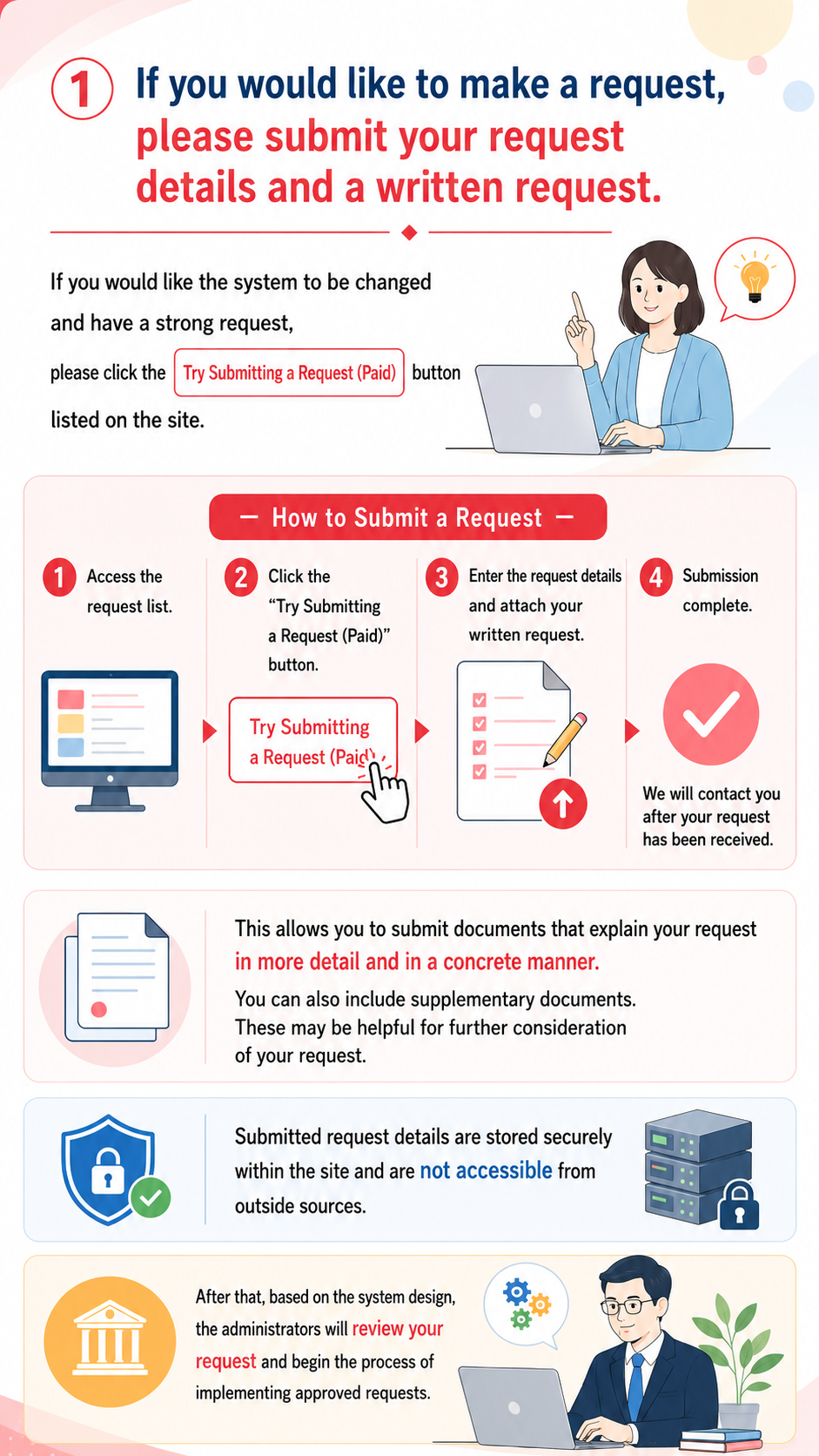
If you wish to pursue institutional reform, please click the "Request an Assessment (Paid)" button displayed on the Petition List page of this website.
From there, you may submit both your request and any supporting documents describing your proposal in detail.
If you include an explanation of the attached documents in the request description, it will help us process your submission more efficiently.
The request and supporting documents you submit will be securely stored within this website. We take every reasonable precaution to ensure that they are not disclosed to any third party.
Once your submission has been received, our Institutional Design Specialists will begin assessing your proposal.
2. Please Pay the Assessment Fee
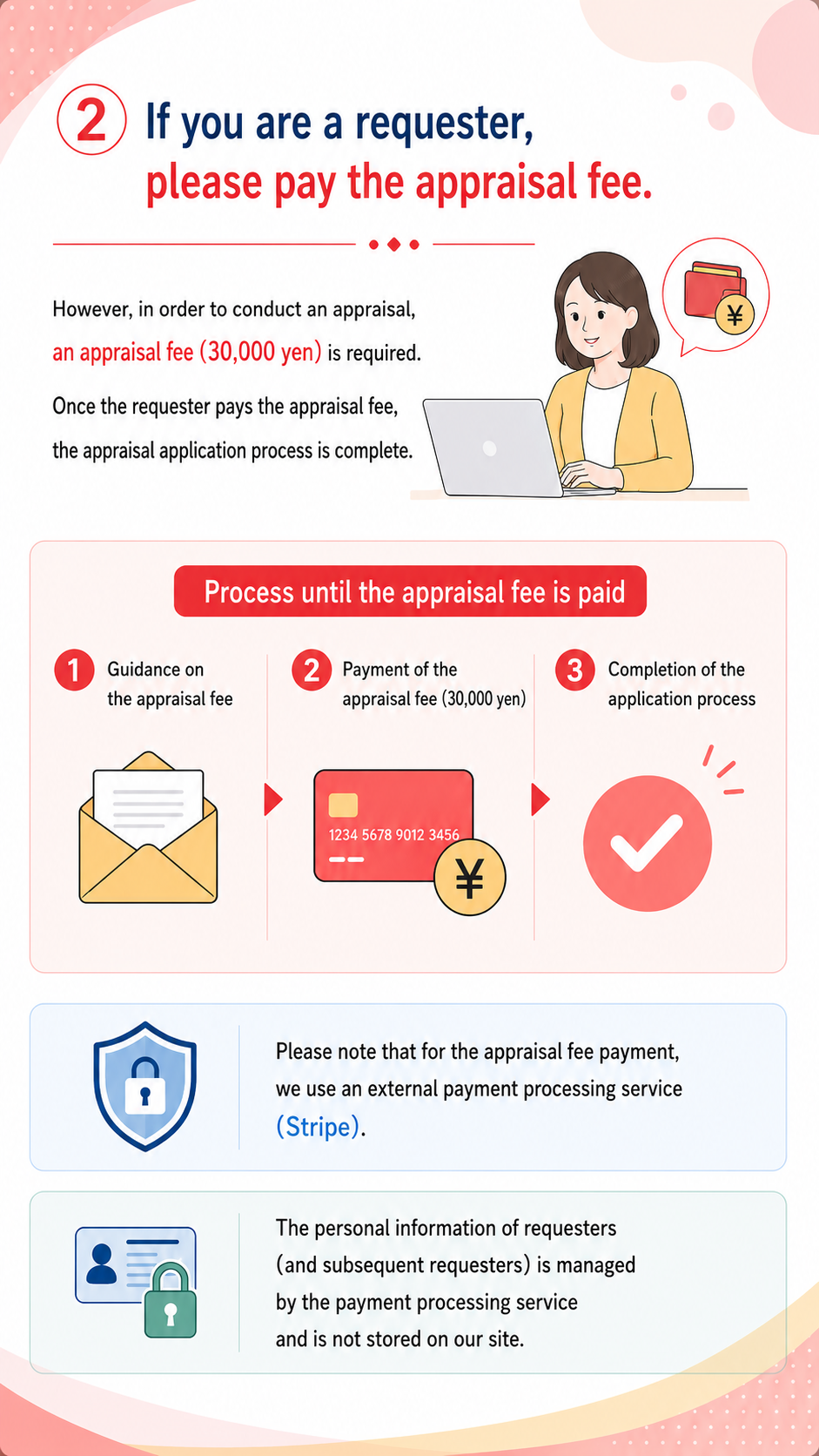
Please note that an assessment fee of JPY 30,000 is required before your request can be evaluated.
Payment of the assessment fee completes your application for assessment.
Assessment fees are processed through the external payment service Stripe. Therefore, the personal information of the person requesting the assessment (hereinafter referred to as the Requester) is securely managed by the payment service provider.
3. We Assess Your Request
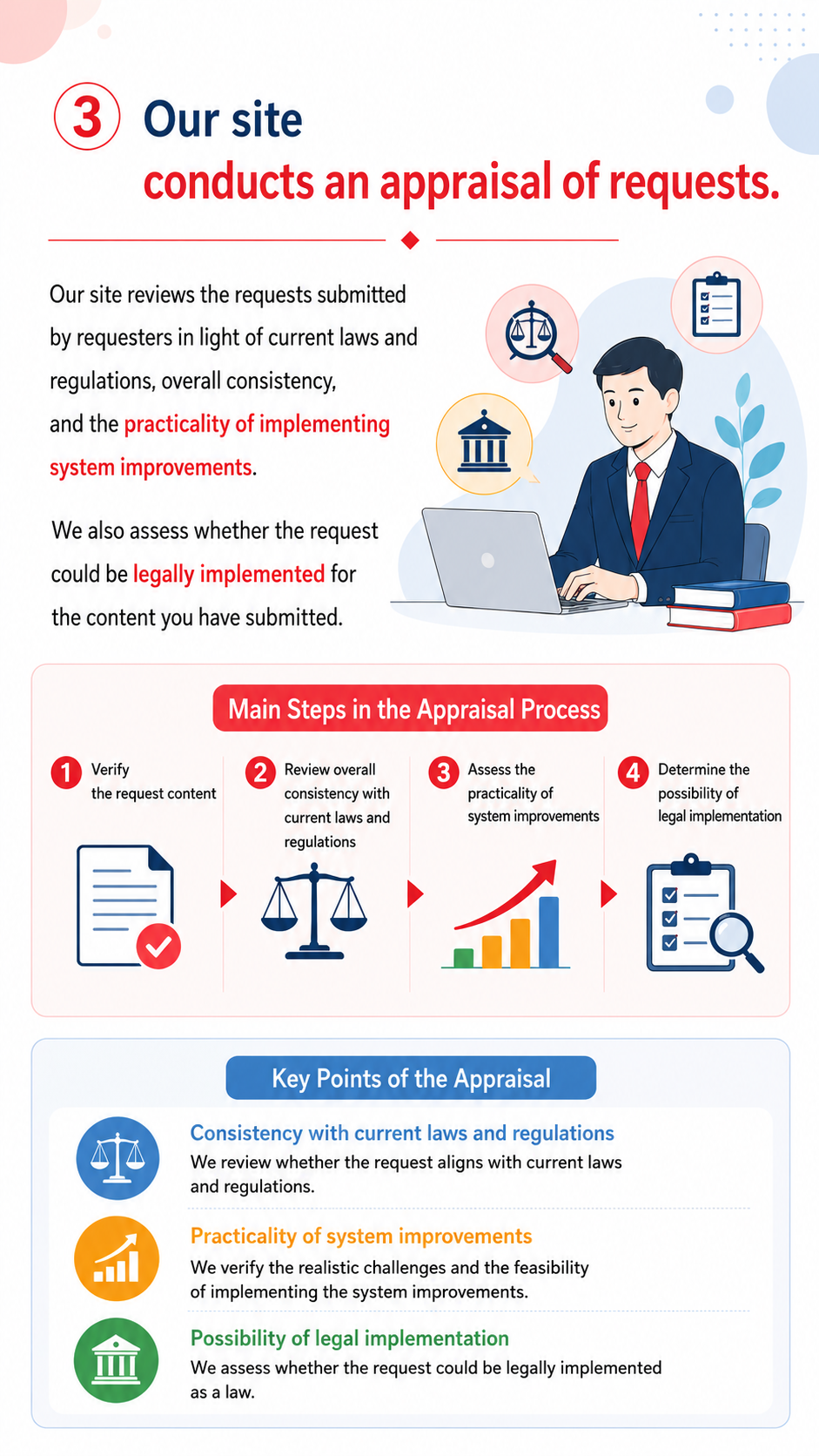
Our Institutional Design Specialists will examine the request submitted by the Requester, reviewing its consistency with existing laws and evaluating the feasibility of the proposed institutional reform.
We will also assess whether the submitted proposal is capable of being transformed into legislation.
4. We Publish the Assessment Results
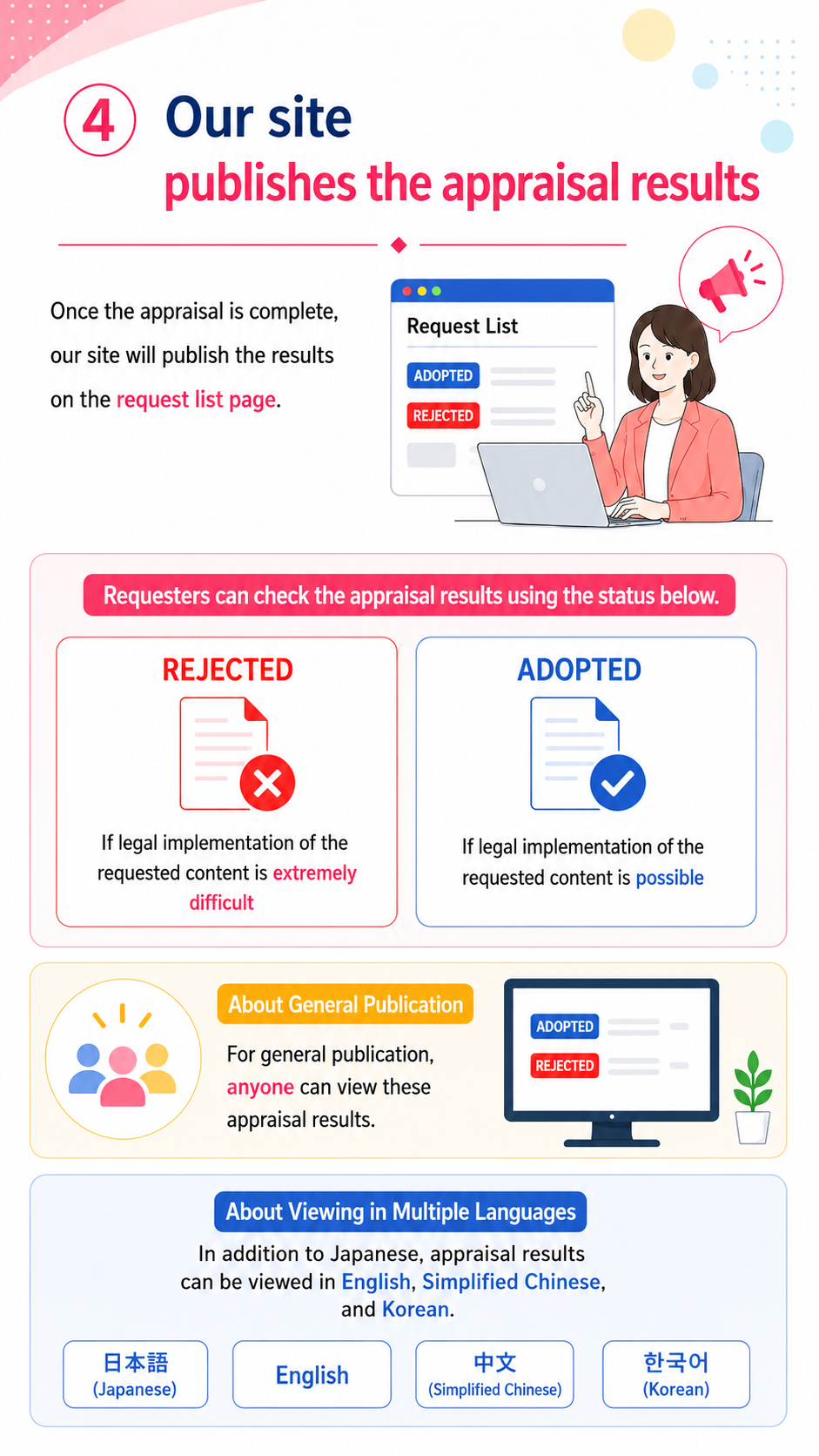
Once the assessment has been completed, the results will be published on the Petition List page of this website.
The Requester may confirm the assessment result using the assigned Reception Number.
The assessment result will be one of the following:
- Rejected — The submitted proposal is considered extremely difficult to convert into legislation.
- Accepted — The submitted proposal is considered suitable for legislative drafting.
Because the assessment results are publicly available, anyone may view them.
Assessment results are published in Japanese, English, Simplified Chinese, and Korean.
5. We Publish the Reason for Rejection
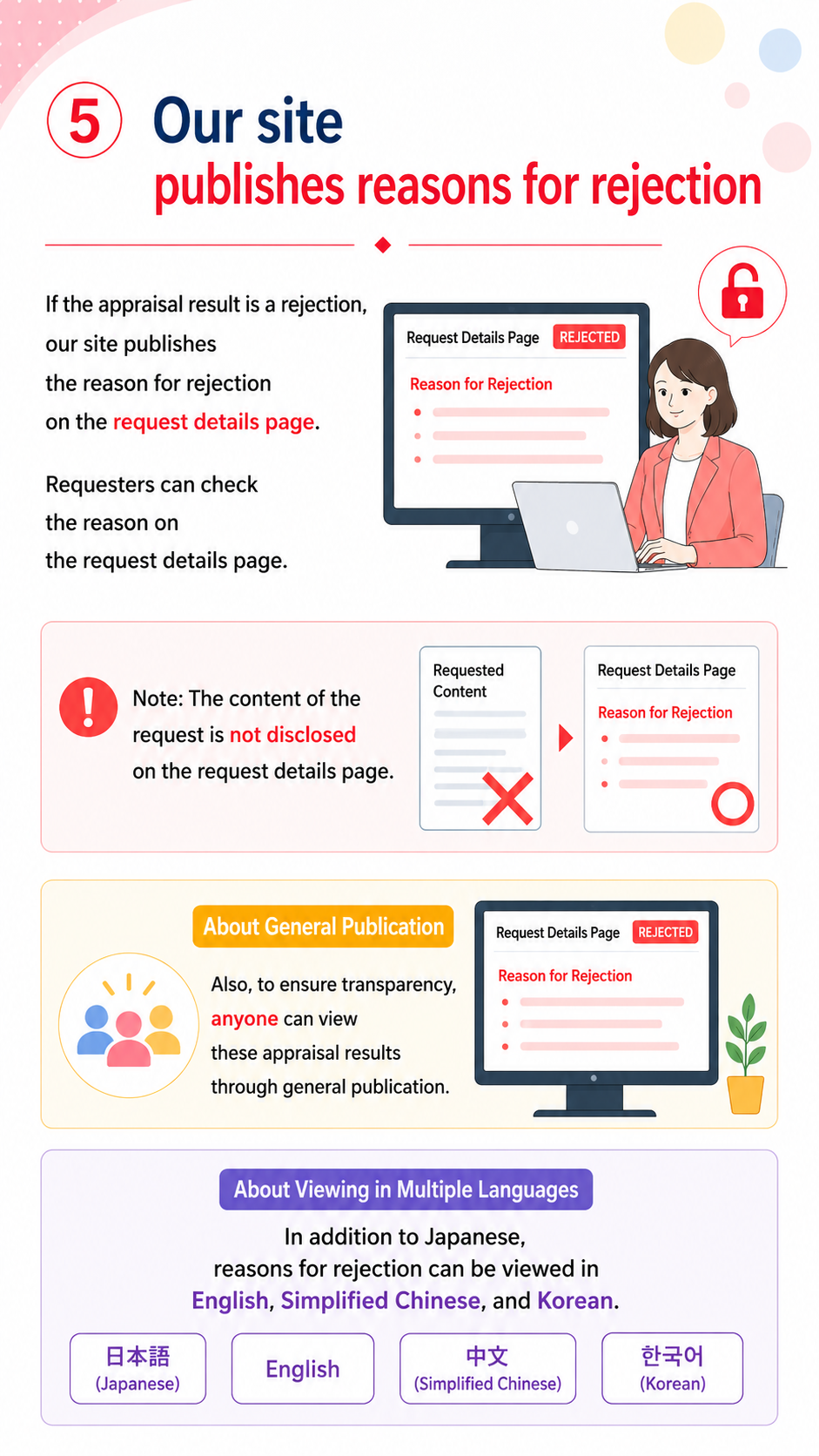
If a request is rejected, this website will publish the reason for the rejection on the Petition Details page.
The Requester may review the reason for rejection on that page.
Please note that the Requester's original submission is not published on the Petition Details page.
Since this information is publicly available, anyone may view the published reason for rejection.
Reasons for rejection are also published in Japanese, English, Simplified Chinese, and Korean.
6. We Refund a Portion of the Assessment Fee
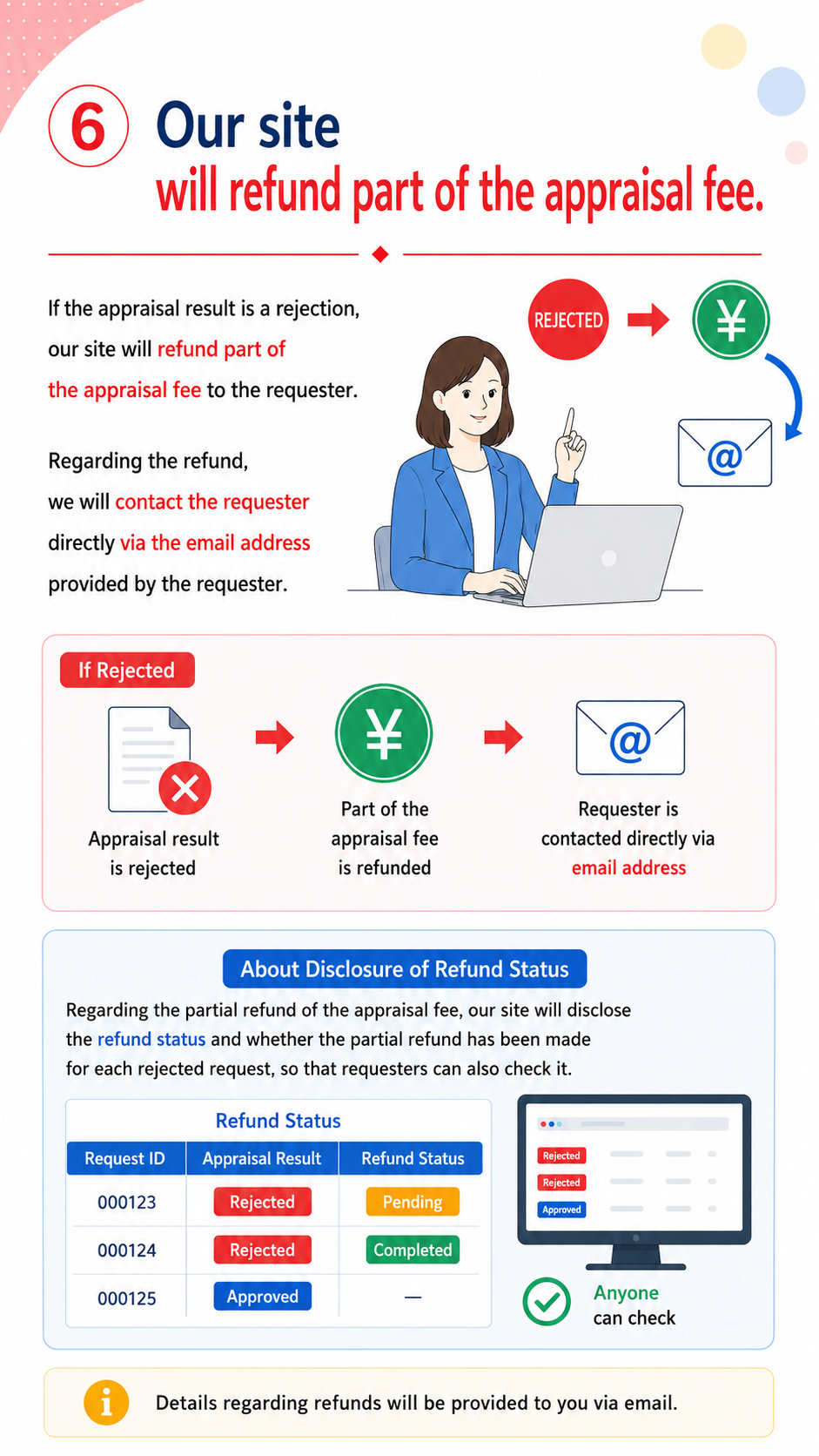
If the assessment result is Rejected, this website will refund a portion of the assessment fee to the Requester.
The refund procedure will be handled by contacting the Requester directly via the email address provided at the time of application.
In addition, this website publishes the refund status so that anyone, including the Requester, can verify whether a partial refund of the assessment fee has been issued for a rejected request.
7. We Publish the Summary
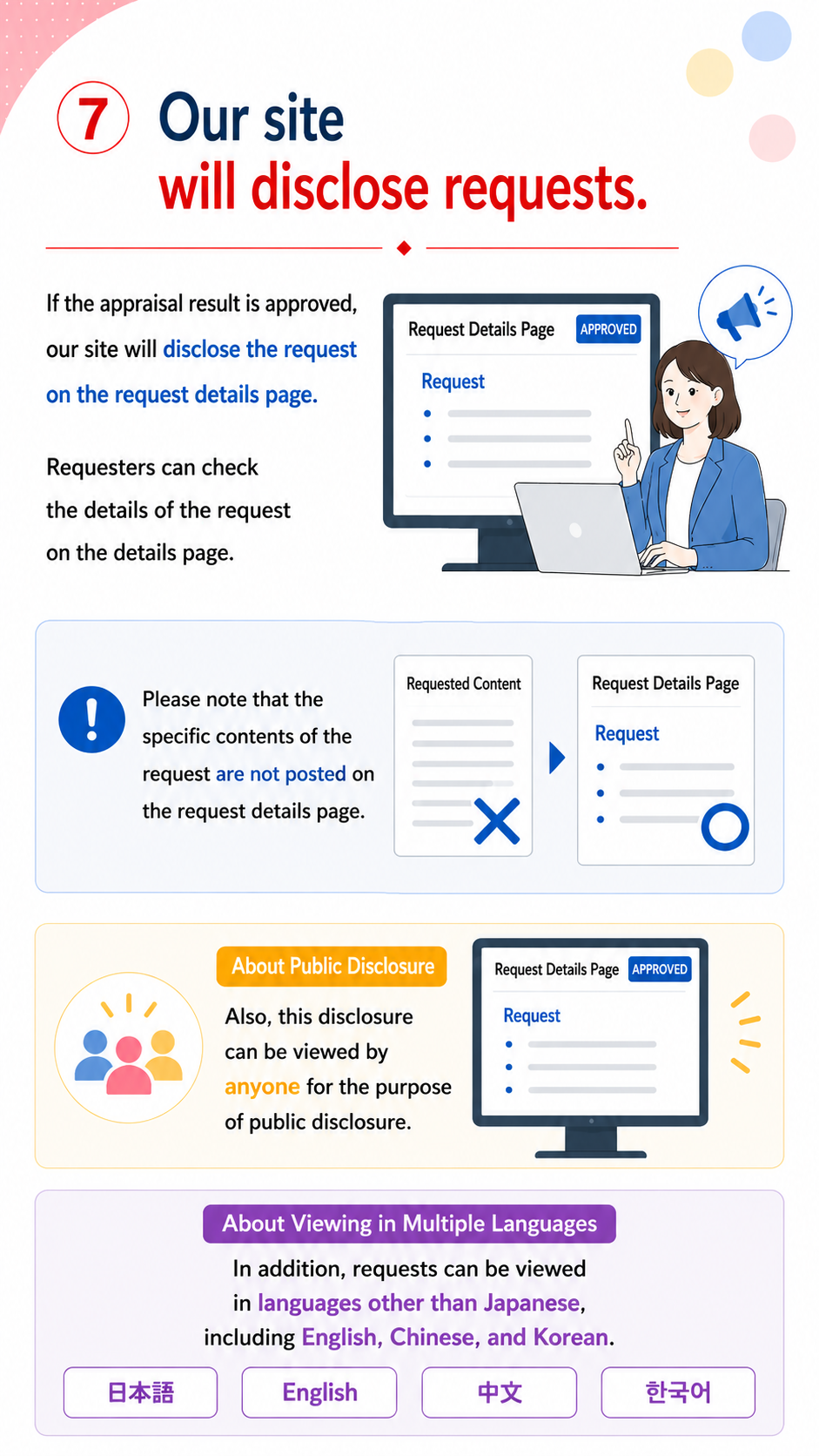
If the assessment result is Accepted, this website will publish a summary of the request on the Petition Details page.
The Requester may review the published summary on that page.
Please note that the Requester's original submission is not published on the Petition Details page.
Since this information is publicly available, anyone may view the summary.
The summary is published in Japanese, English, Simplified Chinese, and Korean.
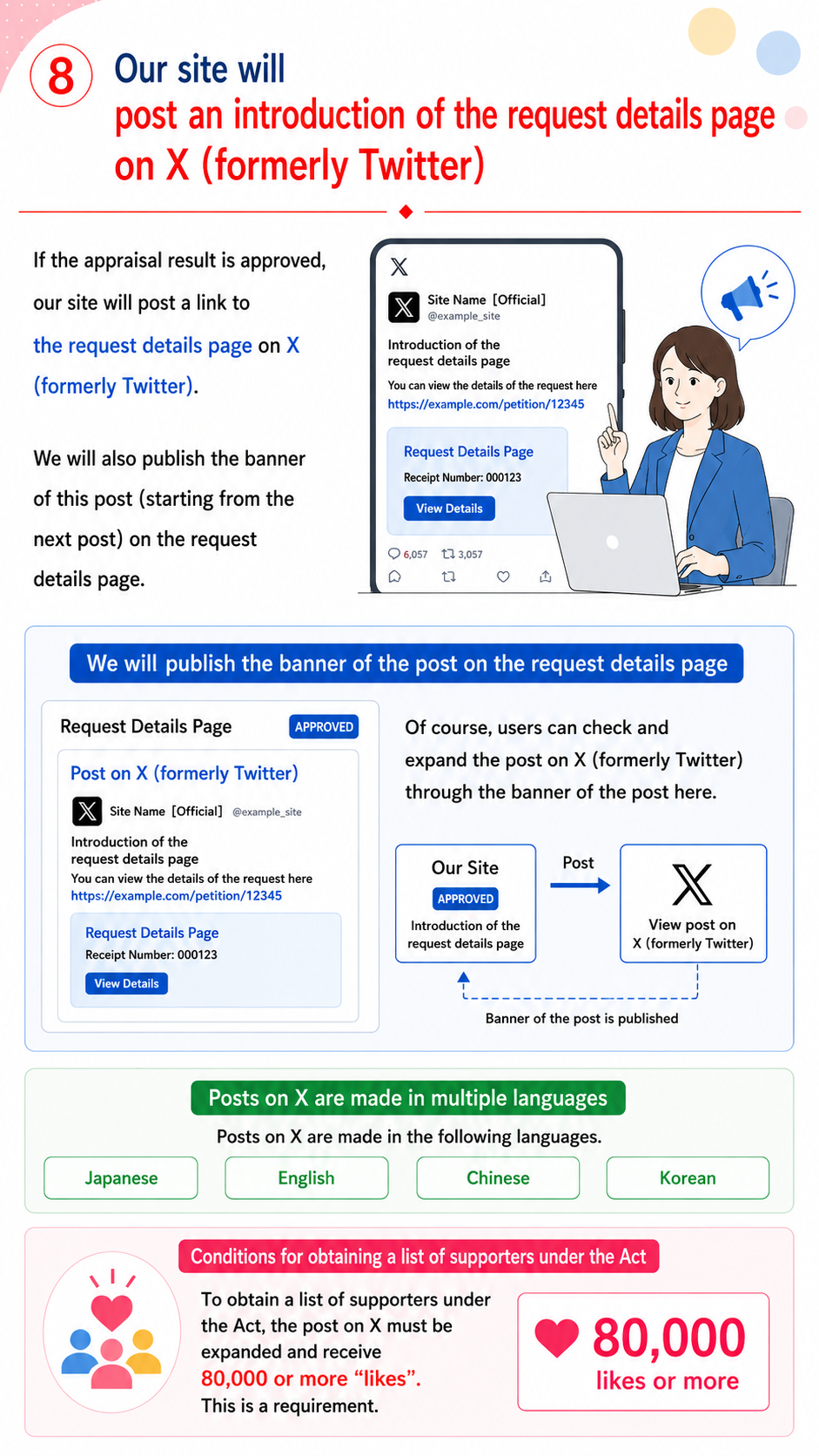
8. We Publish a Post Introducing the Petition Details Page on X (formerly Twitter)
If the assessment result is Accepted, this website will publish a post on X (formerly Twitter) containing a link to the Petition Details page.
A banner linking to that post (hereinafter referred to as the Post) will also be displayed on the Petition Details page.
The Post is published in Japanese, English, Simplified Chinese, and Korean.
To obtain the complete Legislative Package, the Requester must promote the Post and obtain at least 80,000 Likes on X.
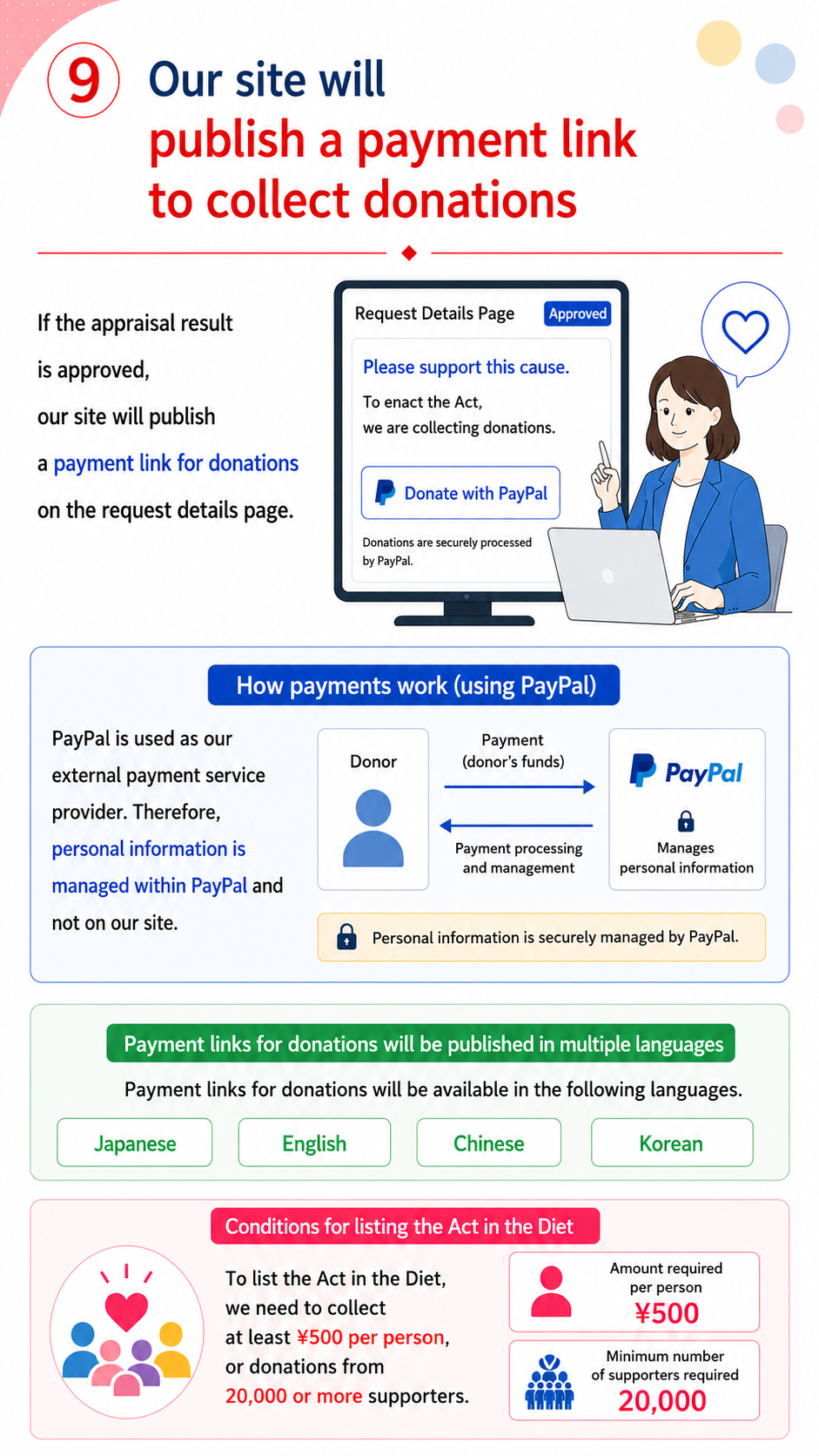
9. We Publish a Contribution Payment Link
If the assessment result is Accepted, this website will publish a contribution payment link on the Petition Details page.
Contribution payments are processed through the external payment service PayPal. Therefore, contributors' personal information is managed by the payment service provider.
The contribution payment link is published in Japanese, English, Simplified Chinese, and Korean.
To obtain the complete Legislative Package, the Requester must collect contributions from 20,000 supporters, with each supporter contributing JPY 500, for a total of JPY 10 million.
10. We Publish the Complete Legislative Package
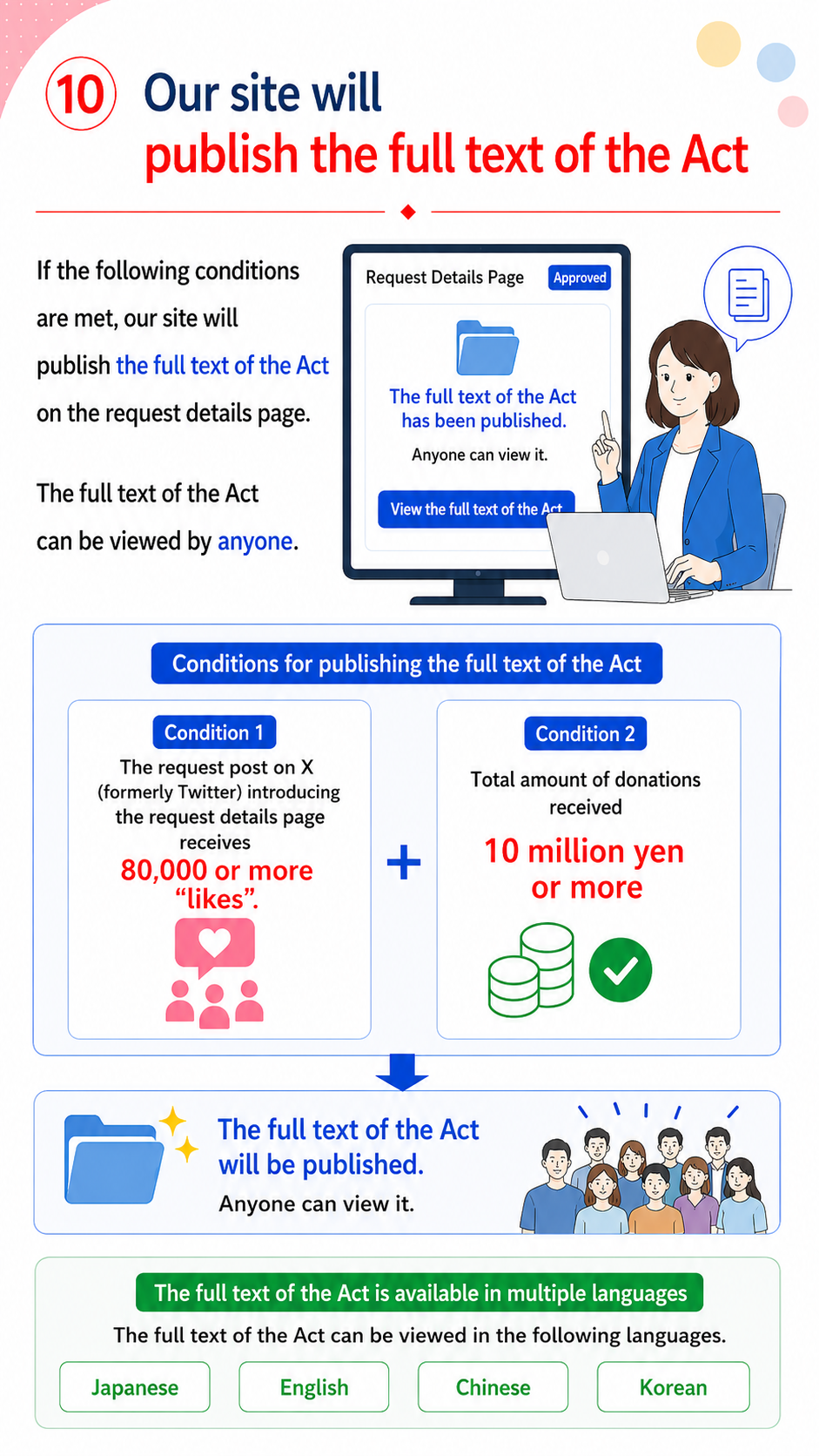
Once the following conditions have been satisfied, this website will publish the complete Legislative Package as additional content on the Petition Details page.
- The Post introducing the Petition Details page has received at least 80,000 Likes on X.
- Total contributions have reached JPY 10 million.
The complete Legislative Package is publicly available for anyone to read.
It is published in Japanese, English, Simplified Chinese, and Korean.
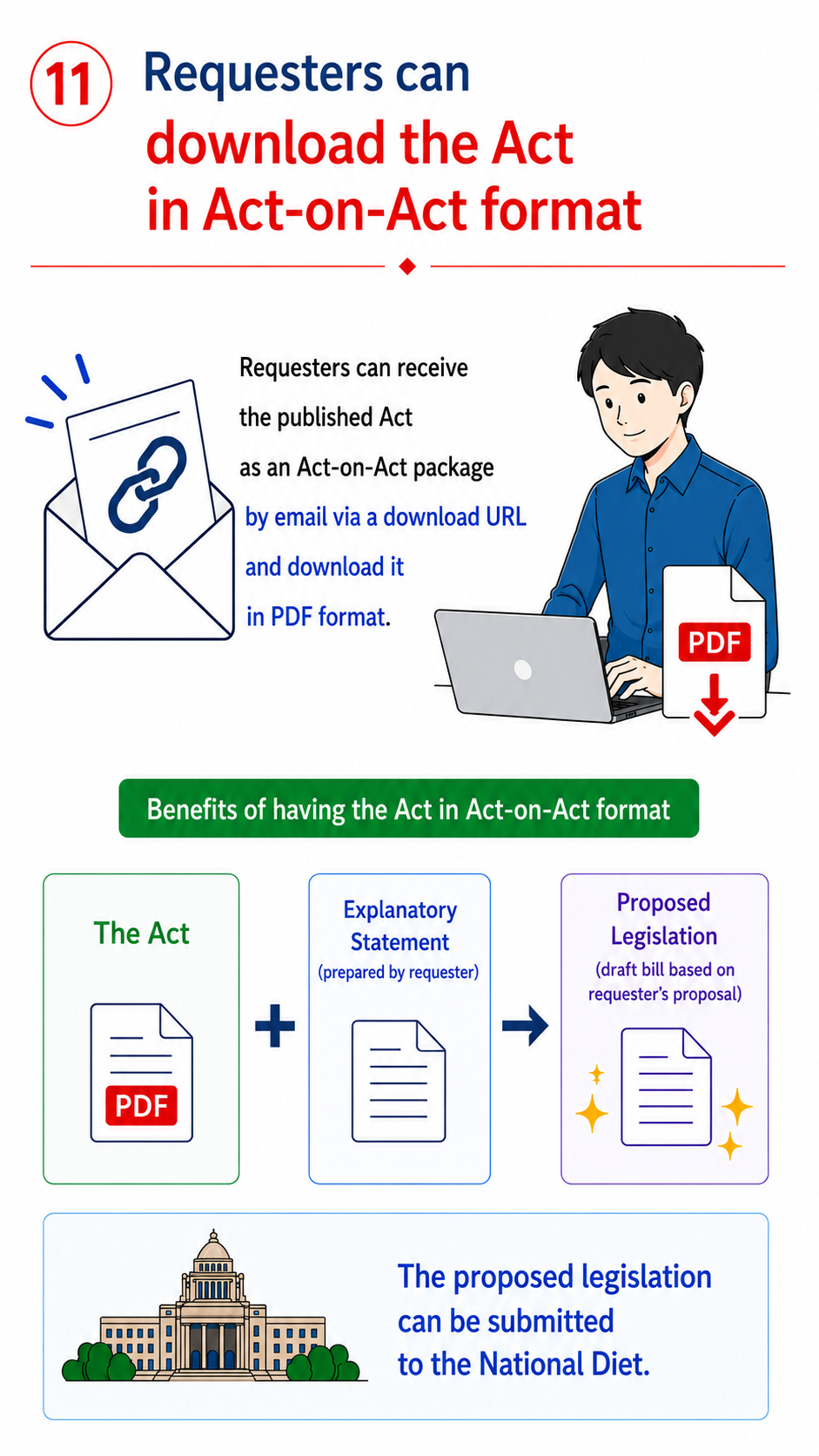
11. The Requester Downloads the Complete Legislative Package
The Requester may download the published Legislative Package as a single package.
By obtaining the complete Legislative Package, the Requester can attach it to a lobbying document. Instead of submitting only a request for institutional reform, the Requester is able to submit to the National Diet an original policy proposal in the form of an Institutional Design Document.
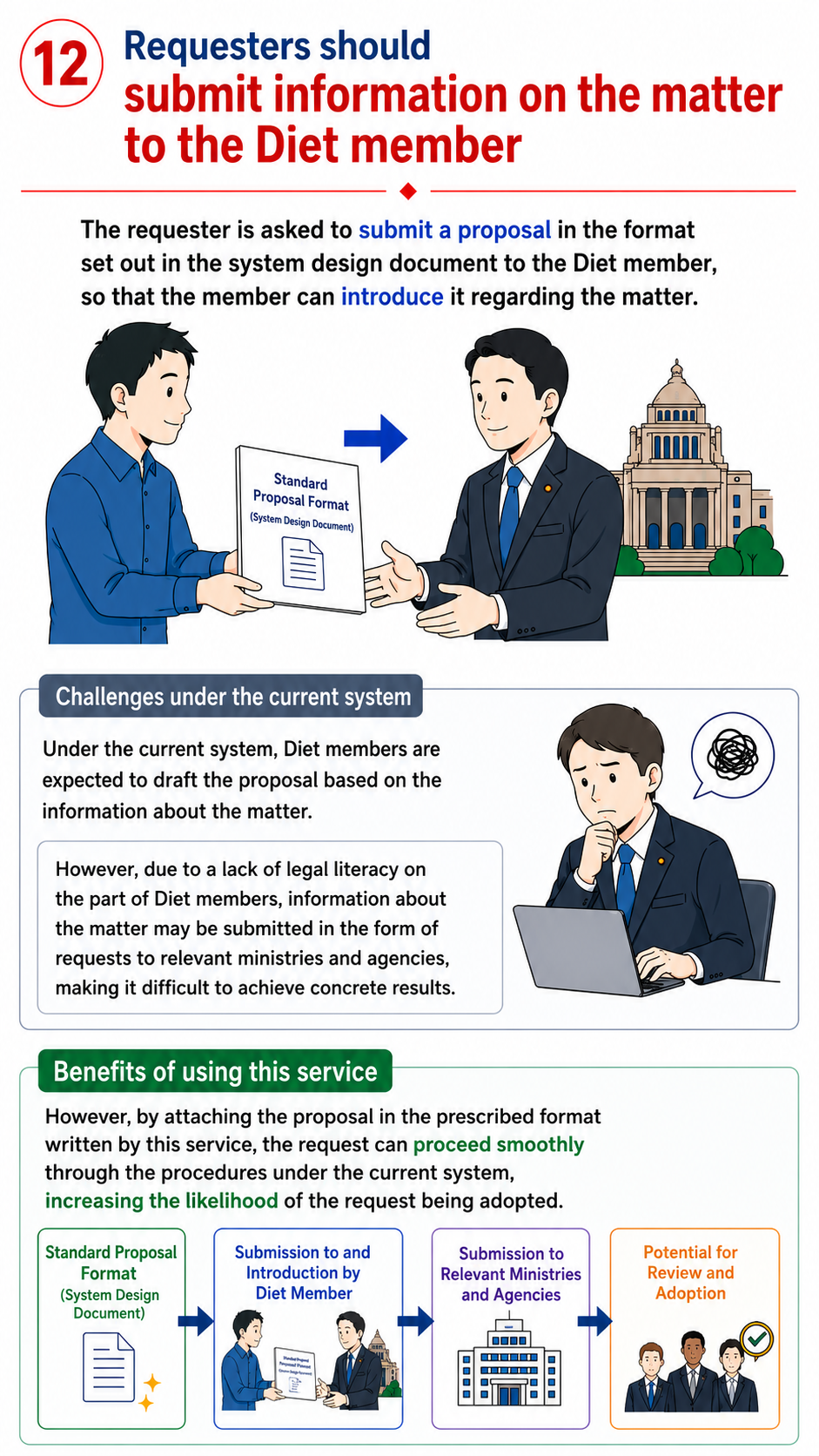
12. The Requester Submits the Lobbying Proposal to a Member of the National Diet
The Requester submits the complete Legislative Package, including the Institutional Design Document, to a Member of the National Diet and requests that the Member introduce the petition.
Under the current system, Members of the National Diet are expected to possess the ability to translate lobbying proposals into legislative bills.
Unfortunately, because many legislators lack sufficient legal literacy, lobbying documents often fail to reach the Petition Committee and are never processed further.
However, by attaching the complete Legislative Package drafted through this service, the petition gains the opportunity to proceed through the existing petition procedures established under the current legal system.
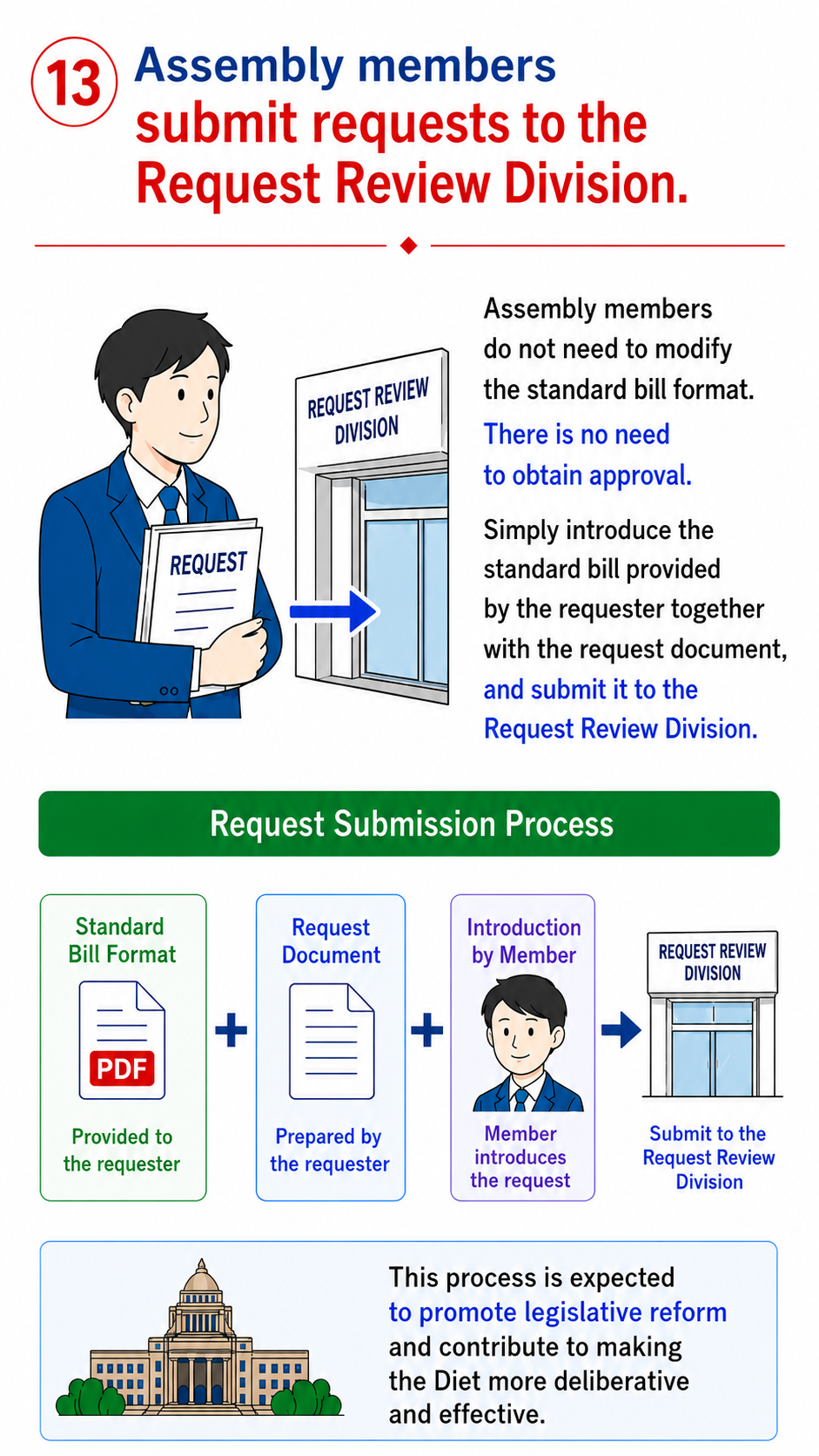
13. A Member of the National Diet Submits the Petition to the Petition Committee
The Member of the National Diet is not required to draft the legislation again.
Instead, the Member simply introduces the complete Legislative Package submitted by the Requester together with the petition and submits it to the Petition Committee.
As a result, the petition becomes eligible to be considered as a petition accompanied by a concrete legislative proposal for institutional reform.
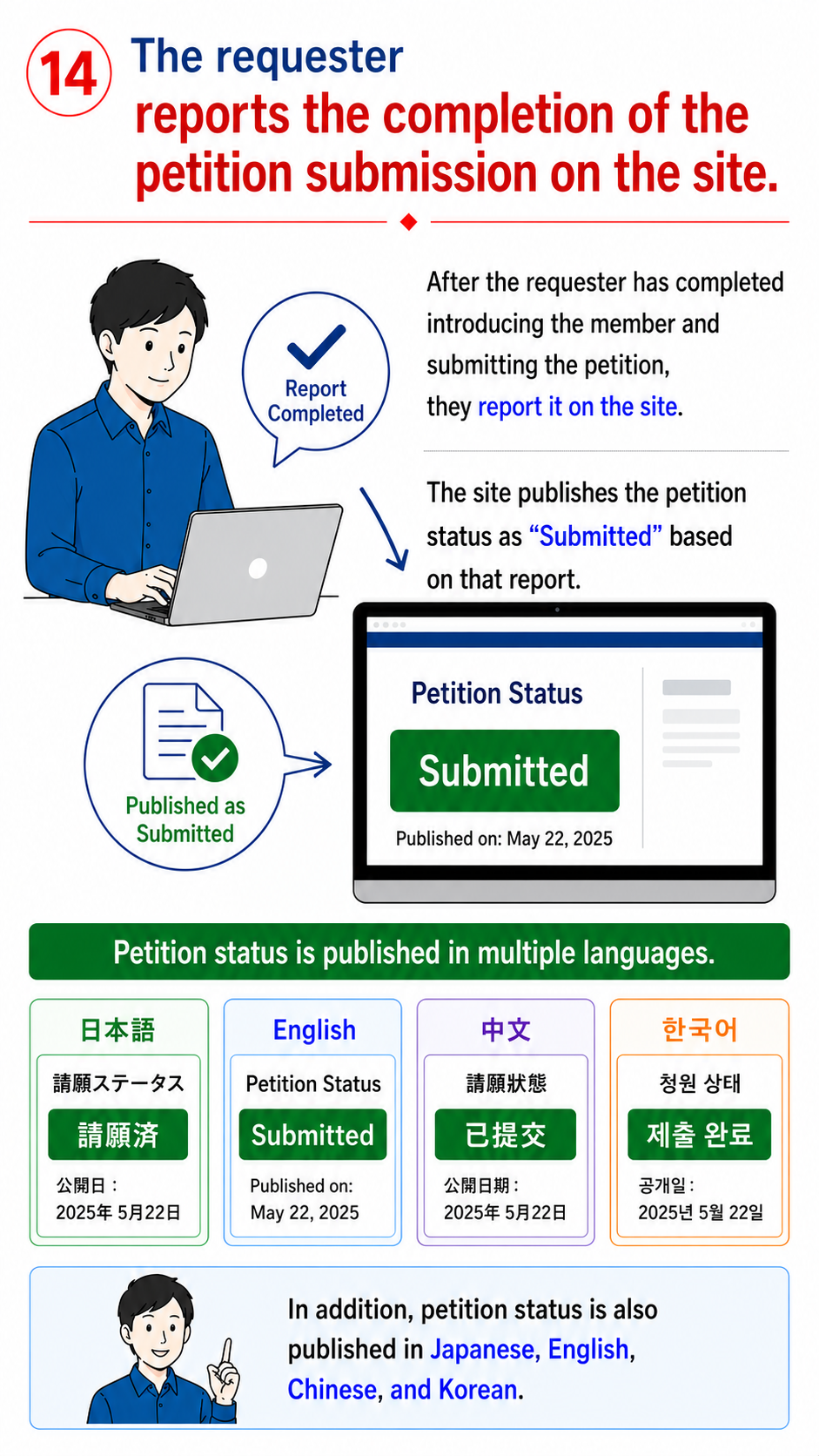
14. The Requester Reports the Completion of the Petition Submission
After completing both the lobbying process with a Member of the National Diet and the submission of the petition, the Requester reports the completion of the petition submission to this website.
Based on this report, the website updates and publishes the petition status as "Petition Submitted."
The petition status is published in Japanese, English, Simplified Chinese, and Korean.
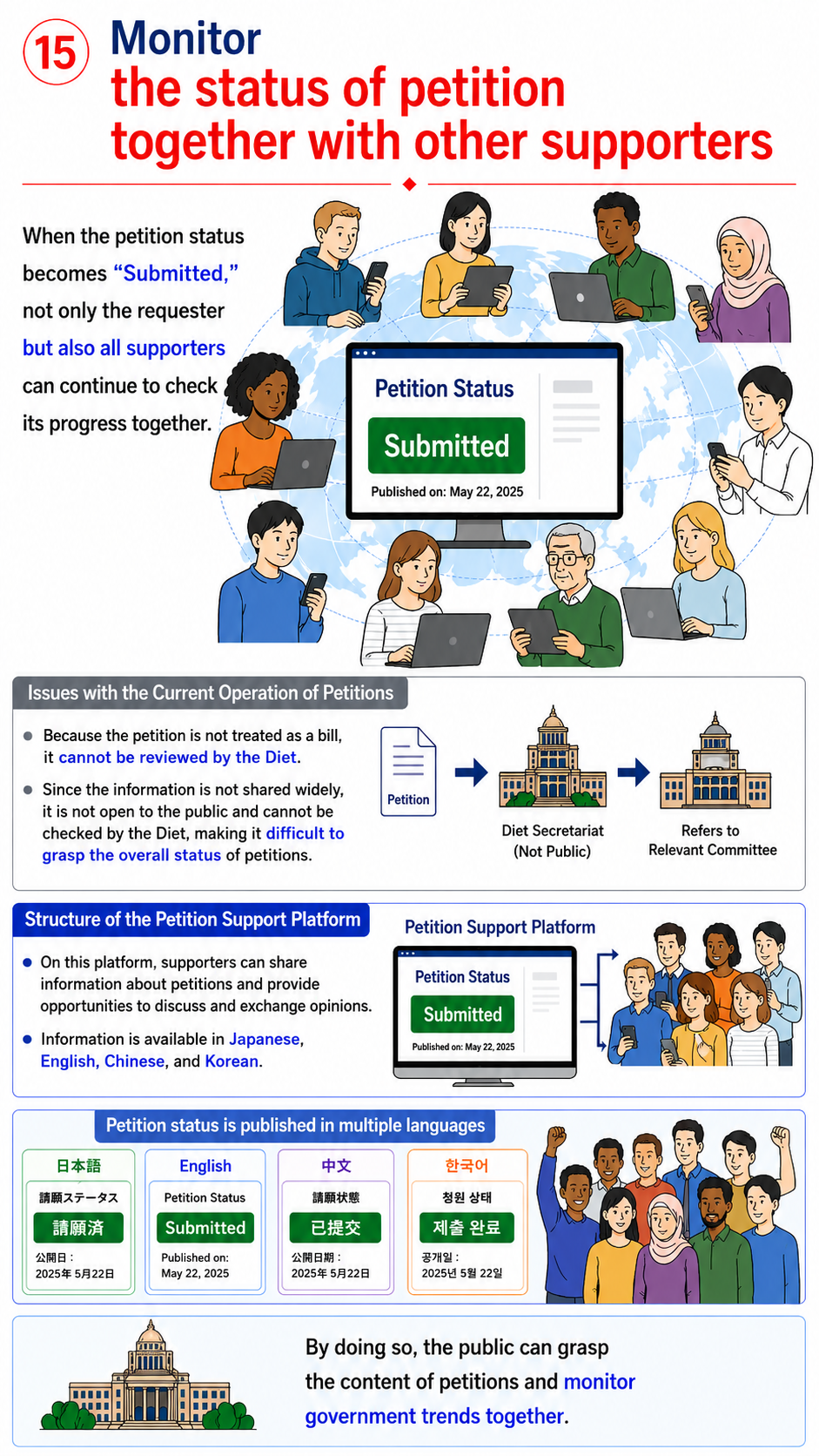
15. Supporters Monitor the Progress of the Petition
Once the petition status has been updated to "Petition Submitted," not only the Requester but also all supporters can continuously monitor the progress of the petition.
Traditionally, petitions are announced through the official publications of the House of Representatives. However, these publications themselves are not publicly accessible.
Furthermore, the published information contains only the petitioner's name and the title of the petition. The detailed contents of the petition can only be viewed at the National Diet Library.
Taking this limited public access and lack of transparency into consideration, the Petition Application Support Service provides a system through which anyone can view the contents of a petition.
Moreover, the petition is published not only in Japanese but also in English, Simplified Chinese, and Korean.
This enables the people of Japan to understand the contents of the petition while monitoring the government's response and progress.
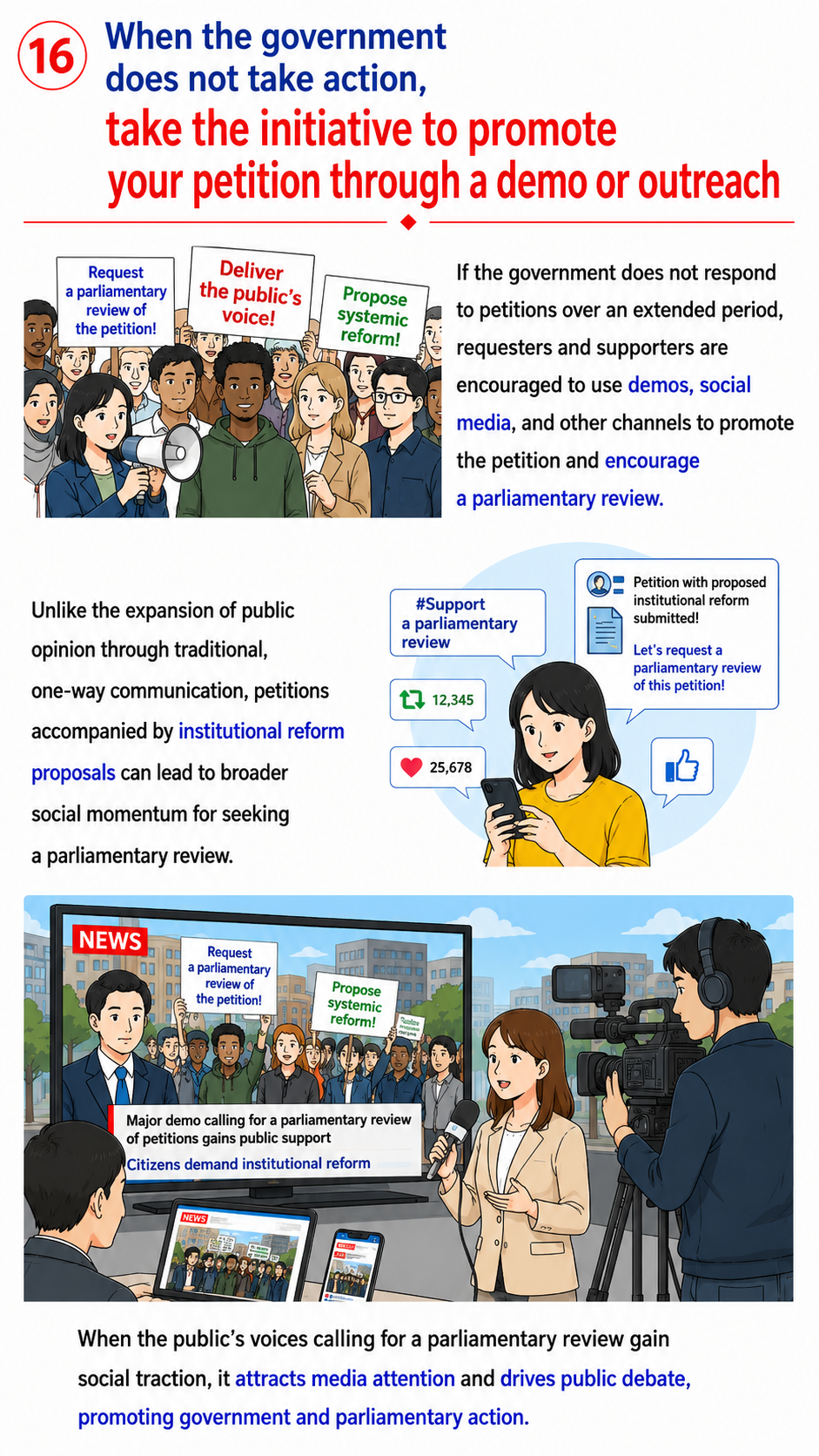
16. If the Government Takes No Action, Public Campaigns Are Encouraged to Advance the Petition
If the government fails to respond to the petition for an extended period, the Requester and supporters are encouraged to organize demonstrations and public awareness campaigns through social media and other channels in order to encourage legislative consideration of the petition.
Unlike conventional demonstrations that merely express public emotion, this petition is accompanied by an Institutional Design Document containing a concrete legislative proposal. As a result, public campaigns can serve as meaningful support for encouraging the introduction of the proposed legislation.
Furthermore, under Article 1 of the Constitution of Japan, if supporters organize a public movement at the Imperial Palace to directly appeal to the Emperor to encourage the introduction of the petition, it will become considerably more difficult for the National Diet to ignore the petition.
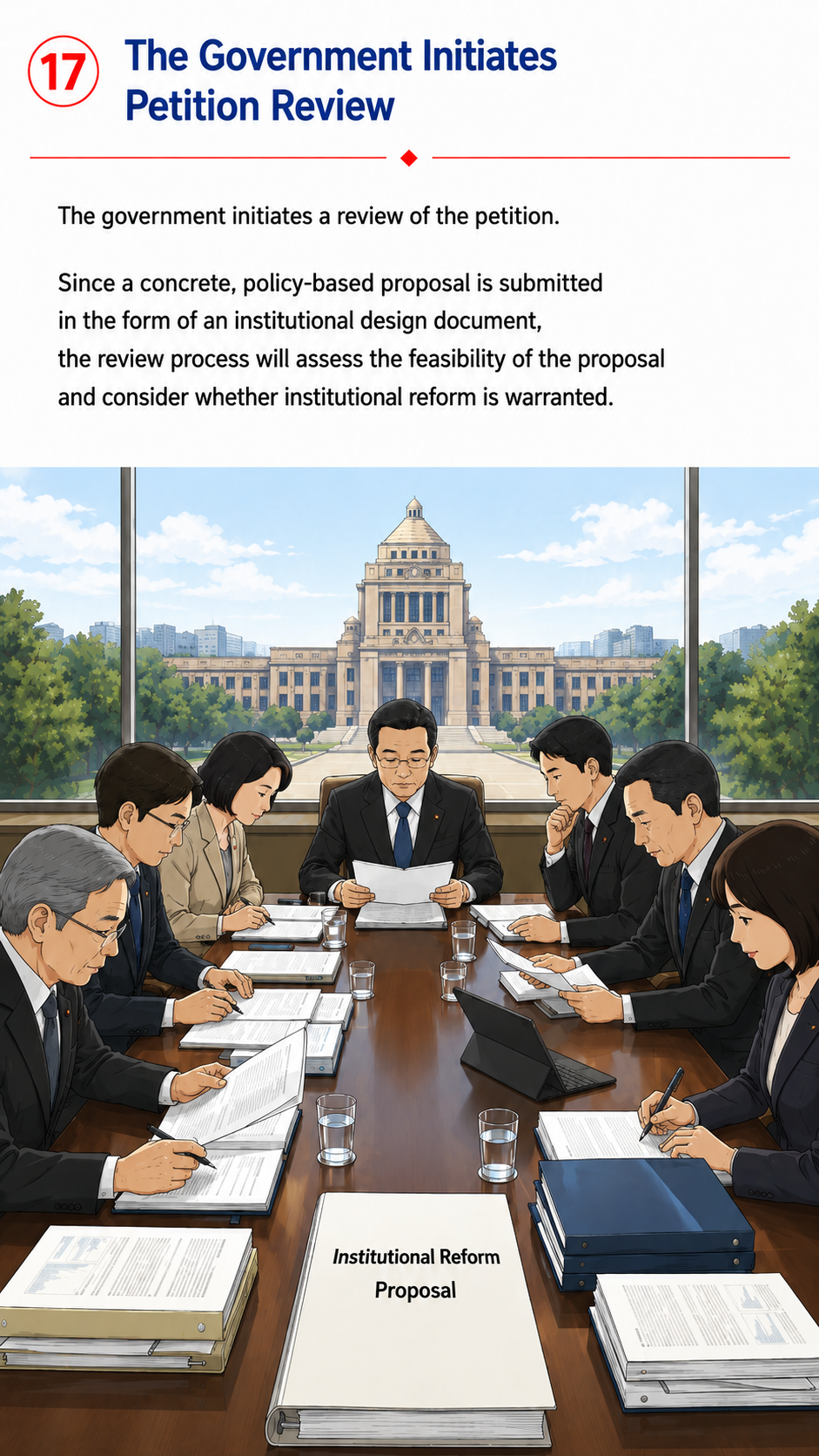
17. Government Deliberations Begin
The government begins deliberations on the petition.
Because a complete Legislative Package has already been submitted in the form of an Institutional Design Document, deliberations proceed on the basis of the proposed legislation to determine whether the requested institutional reform should be adopted.
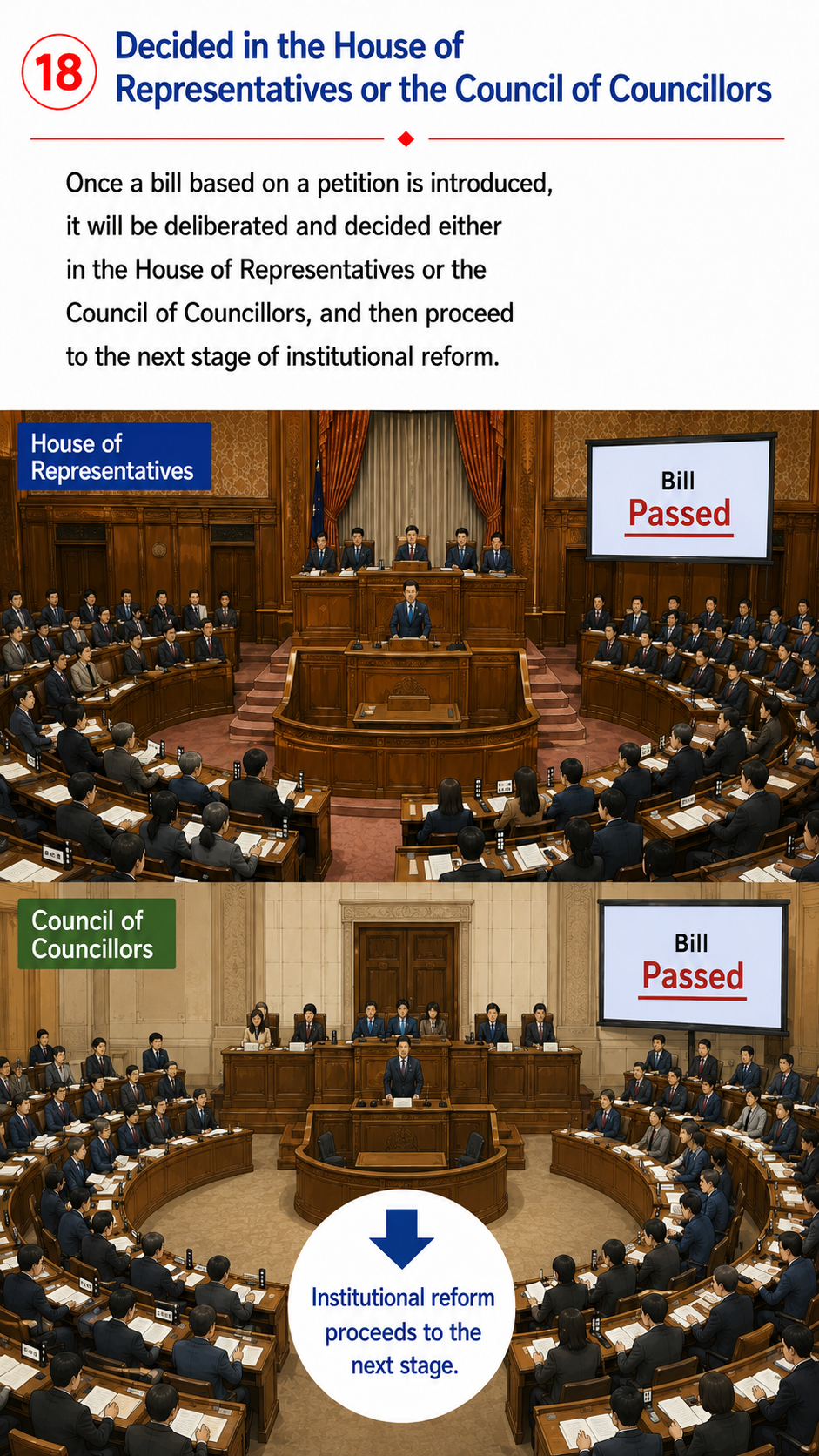
18. Approval by the House of Representatives and the House of Councillors
Once legislation based on the petition has been formally introduced and subsequently approved by both the House of Representatives and the House of Councillors, the institutional reform proceeds to the next stage.
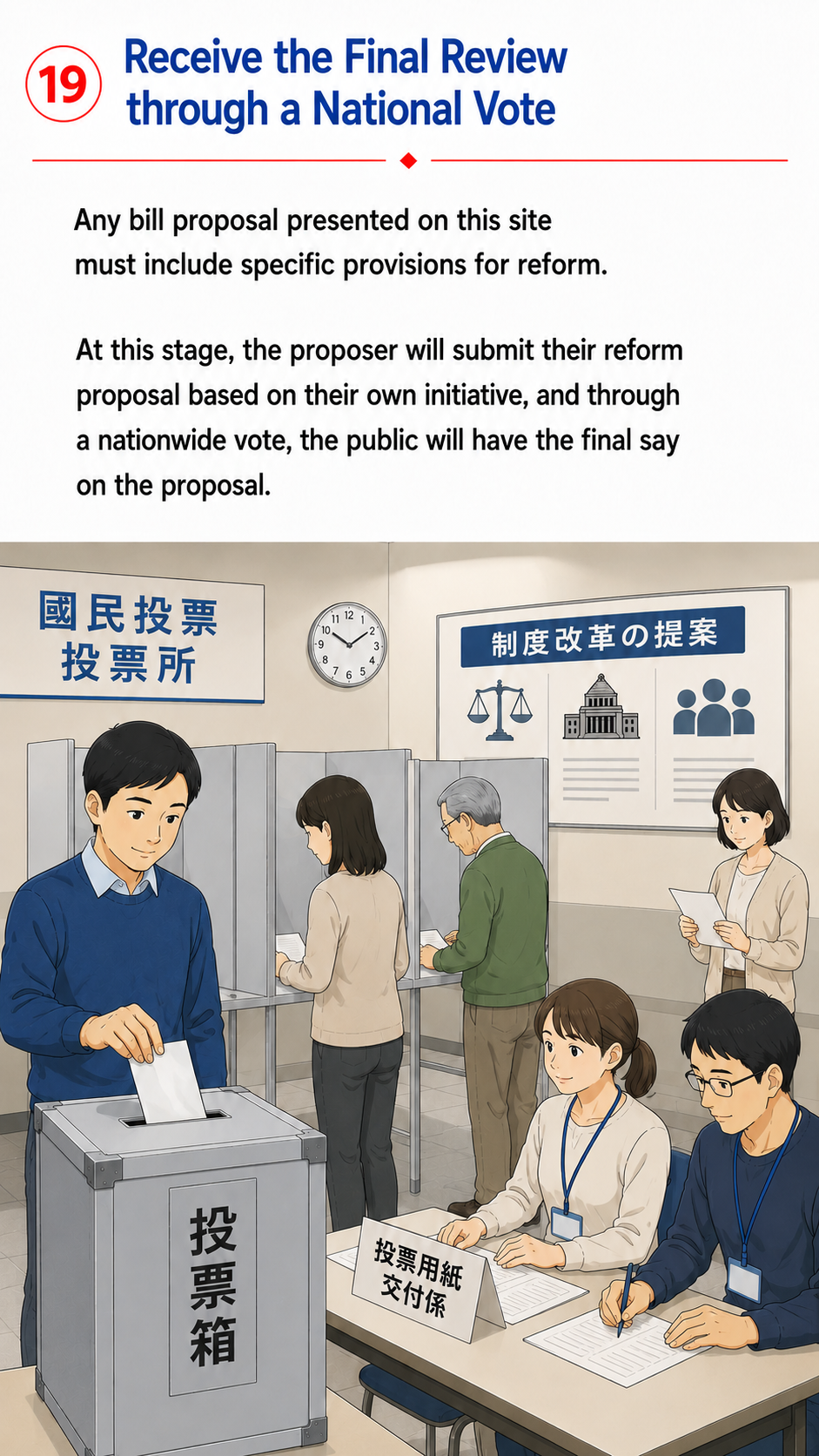
19. The Final Review Is Conducted Through a National Referendum
The complete Legislative Package presented by this website always includes proposed constitutional amendments.
At this stage, the Requester's proposal for institutional reform is submitted to the people of Japan for a final nationwide review through a National Referendum.
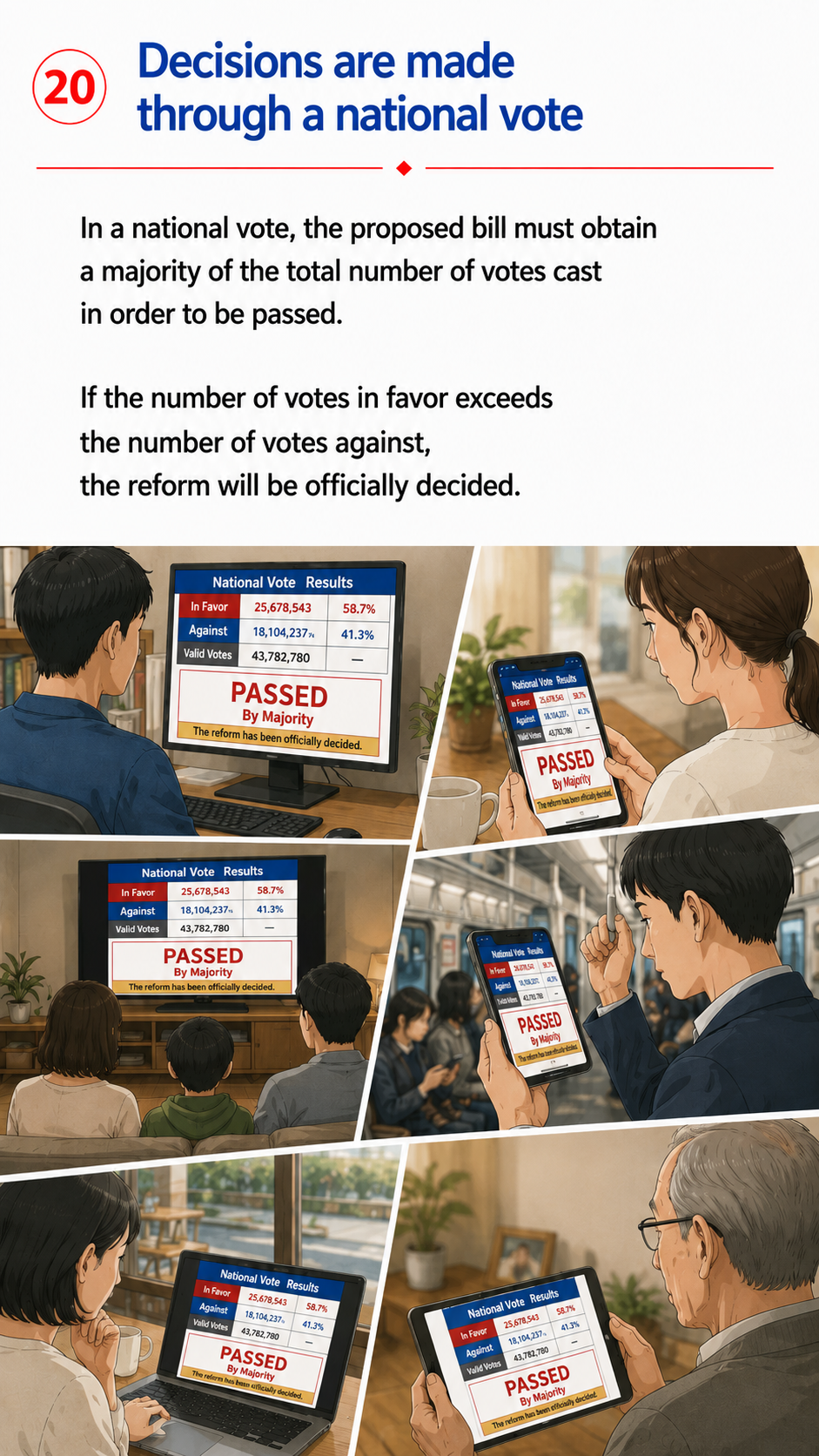
20. Approval by National Referendum
Under the current legal framework governing national referendums, a proposal is approved if it receives a majority of the valid votes cast.
If a majority votes in favor, the proposed institutional reform is formally approved.
21. The New System Takes Effect on the Enforcement Date Specified in the Legislative Package
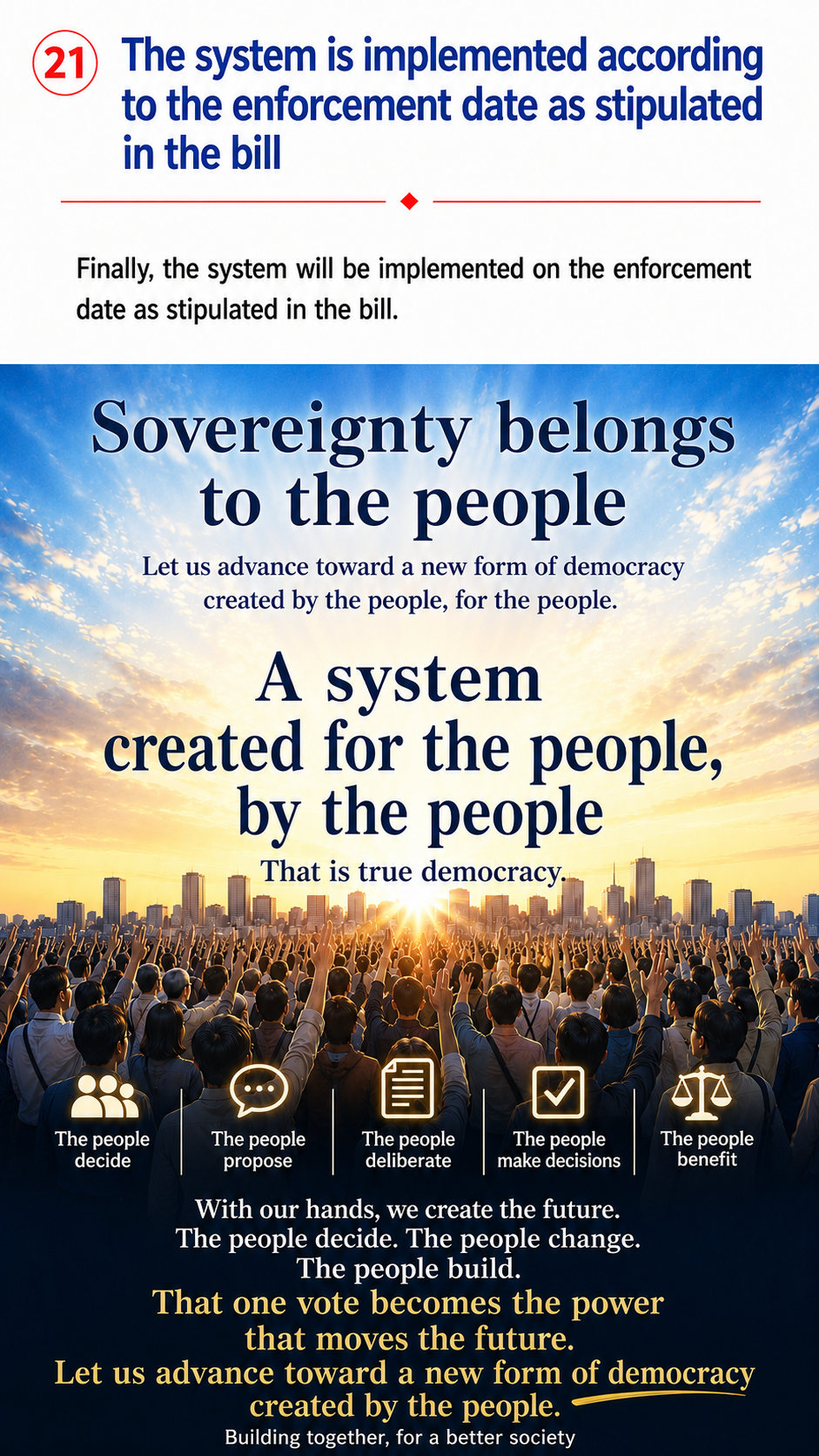
Finally, the new legal system comes into force on the enforcement date specified in the complete Legislative Package.
At that point, the proposed institutional reform is formally implemented.
This service provided by the Petition Application Support Service is not a fantasy or an unrealistic concept.
It is a practical institutional reform service that has been carefully designed in accordance with the existing legal framework and procedures.
We believe that no such service has emerged from the end of World War II to the present day because legal literacy has not been sufficiently developed across any political party, and because the sovereign people have never been given adequate opportunities to study the law through the formal education system.
The Petition Application Support Service is not merely a website that assists people in submitting petitions.
One of the principal objectives of this service is to improve legal literacy by making complete Legislative Packages publicly available, encouraging people to read them, think about them, and engage in informed discussion.