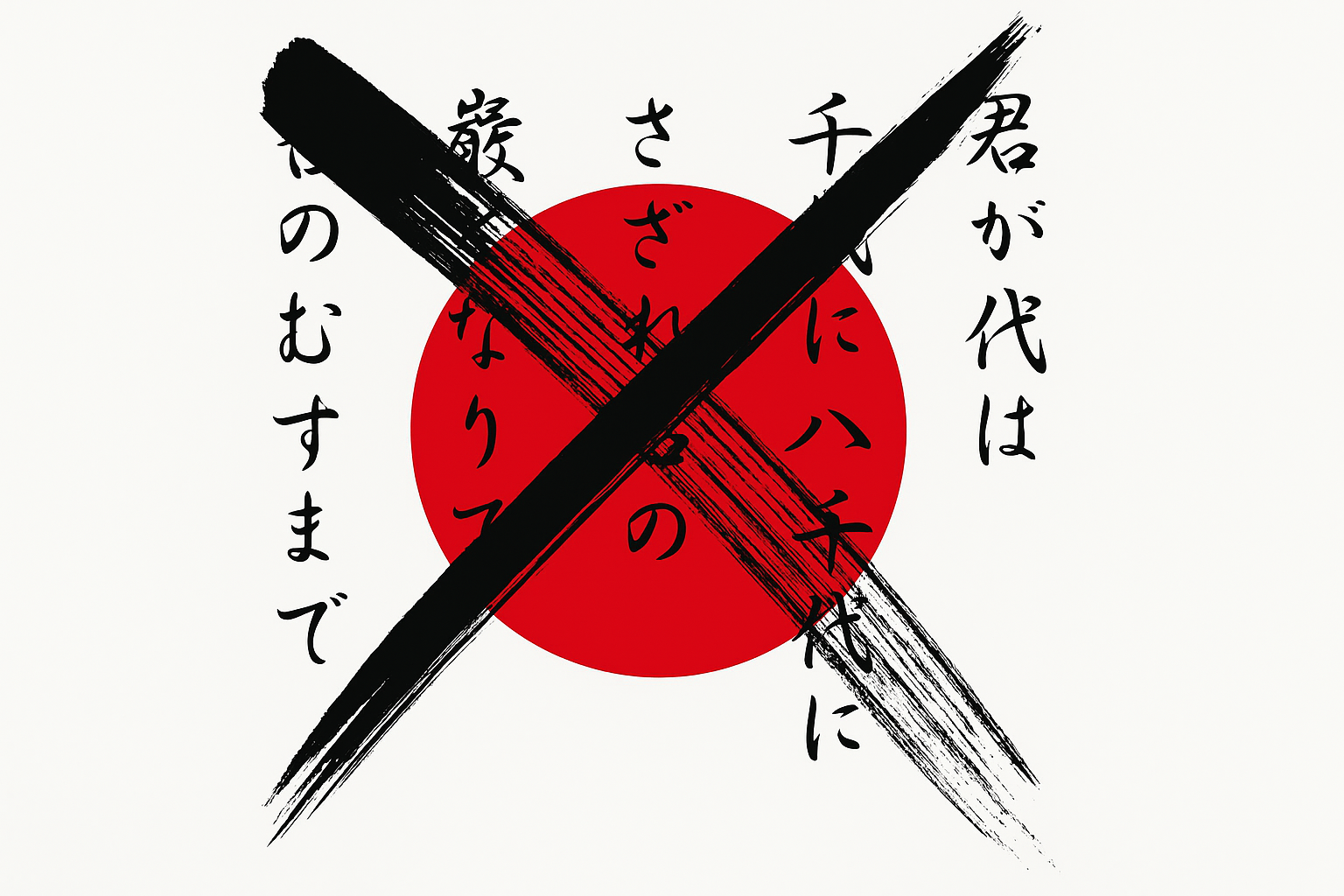

Constitutional and Historical Critique of the Proposed Amendment to the Penal Code Introducing a National Flag Desecration Offense
Statement 1 – Lack of Historical Legitimacy
The Hinomaru was not established through any legitimate national process but was adopted merely as a merchant ensign under coercive pressure from Commodore Perry during the late-Edo negotiations. The subsequent Taishōkan Proclamation issued by the Meiji government amounted only to an administrative directive regulating commercial vessels and never possessed the character of a democratically enacted national symbol. It imposed an emblem upon the people without consent or legislative due process.
Statement 2 – Structural Defects in the Legal Framework
Postwar Japan designated the national flag for the first time through the 1999 Act on National National Flag and National Anthem, without any democratic procedure such as a national referendum. The Act functions as a political device to sacralize state symbols rather than a product of the people’s will. It represents a legal veneer intended to legitimize an imposed symbol, not an authentically democratic enactment.
Statement 3 – Constitutional Contradiction with Freedom of Expression
Given its historical origins, the Hinomaru may reasonably be regarded by some citizens not as an emblem of pride but as a mark of subjugation. Negative treatment of the flag therefore constitutes a legitimate form of political opinion. The proposed Penal Code amendment (Article 94-2) rests on a non-constitutional premise that the State is sacred and immune from criticism. Such a notion directly conflicts with constitutional principles and renders the proposal an unmistakably unconstitutional statute.
Statement 4 – Criminal Regulation of Symbols Chills Speech
Criminalizing acts against national symbols inevitably suppresses political criticism and corrodes the foundations of democratic discourse. When the State shields its symbols through penal sanctions, freedom of thought and expression becomes hollow in practice. A democracy must protect, not punish, dissent regarding its emblems.
Statement 5 – Political Device Preceding Emergency-Powers Reform
The ongoing attempt to introduce a constitutional emergency clause faces broad public resistance. The present bill appears to function as a preliminary measure: normalizing symbolic control through an easier legislative pathway in order to pave the way for broader constitutional restrictions. It risks establishing de facto authority to suppress expression without constitutional amendment, thereby preparing the terrain for emergency-powers expansion.
Recommendation – Explicit Constitutional Protection of Symbolic Expression
In a democratic society, national symbols must remain open to criticism, satire, rejection, or reinterpretation by the citizenry. Therefore, the Constitution should explicitly guarantee that no act concerning national symbols may be criminalized when performed as political expression. Only through this can the State be prevented from exercising symbolic domination over its people.
Proposed Constitutional Provisions (Draft)
Article 21-2 – Freedom of Symbolic Expression
The people shall have the freedom to alter, damage, reject, deny, or employ the national flag, national anthem, or any other state symbol as a form of political expression.
No criminal or administrative sanction shall be imposed for acts concerning state symbols when such acts constitute the expression of thought, belief, or political opinion.
Article 98-2 – Prohibition of Emergency-Powers Provisions
Japan shall not establish in its Constitution or in any statute any provision that suspends, temporarily suspends, or produces effects equivalent to the suspension of the Constitution, including any so-called emergency clause or extraordinary-powers clause.
The National Diet and the Cabinet shall not enact legislation, ordinances, or orders that restrict constitutionally guaranteed fundamental rights or suspend constitutional order on the grounds of an emergency.